
Adding a XenServer host monitor
XenServer (formerly Citrix Hypervisor) is a Type 1 hypervisor that virtualizes physical servers and runs multiple VMs on shared hardware.
Site24x7 provides comprehensive monitoring support for XenServer infrastructure as a centralized visibility and performance management platform, helping administrators to oversee host health, VMs, storage repositories, and network interface card (NICs) in a single console.
With XenServer monitoring, you can:
- Manage XenServer hosts and their associated virtual machines using XenAPI.
- Monitor host-level performance metrics, including CPU, memory, speed, MTU, and network utilization.
- Track VM availability, power state, and resource consumption effectively.
- Oversee storage repositories to identify capacity or latency issues promptly.
Prerequisite
-
Install the latest version of Site24x7's On-Premise Poller on a Windows or Linux server.
Adding a XenServer Host
To add a XenServer host, follow the steps below:
- Log in to your Site24x7 account.
- Navigate to VMware > XenServer Resources.
- Click the plus icon + beside XenServer Host.
- Select Install On-Premise Poller if you don’t have any existing ones set up to monitor your XenServer resources. Then, follow the steps to add an On-Premise Poller. Once added, select the required On-Premise Poller as given in the next step.
- If you already have an On-Premise Poller installed, click Choose On-Premise Poller and select the required one. Then, click Next. On the Add XenServer Host page, specify the following information to add the XenServer host monitor:
- Display Name: Specify a name to identify the XenServer host name.
- XenServer Host Hostname or IP Address: Specify the IP address or domain name of the XenServer host.
- Port: Specify the port number where the XenServer host is running. The default port number is 443.
- Check Frequency: Choose a polling frequency from the drop-down menu.
- Monitoring Locations: Select the location from the drop-down menu from where the XenServer host can be monitored. To learn more, refer to location profiles.
- Dependent on monitor: From the drop-down menu, select the monitor on which this monitor depends. You can add up to five monitors. Site24x7 will suppress alerts for the configured XenServer host monitor if the dependent monitor is already down.
- XenServer Host Credentials: Choose the appropriate credentials stored in the Site24x7 credential profile or add new ones.
- Discover and Auto-add resources:
- Virtual Machines: Toggle Yes to enable monitoring for every VM in the XenServer host. The discovered VMs will be listed under VMware > XenServer Resources > XenServer VM.
- Specify the following details for Configuration Profiles:
- Threshold and Availability: Select a threshold profile from the drop-down menu, use the default threshold profile available, or create a new one, and get notified when the resources cross the configured threshold and availability.
- Tags: Associate your monitor with a predefined tag or multiple tags to help organize and manage your monitors creatively.
- IT Automation Templates: Select an automation to be executed when there is a change in the state of a XenServer host. The defined action gets executed when there is a state change, and selected user groups are alerted.
- Execute IT Automation during Scheduled Maintenance: Select the check box if you wish to execute IT automation during scheduled maintenance.
- Specify the details for Alert Settings:
- User Alert Group: Select the user group that needs to be alerted during an outage. You can add multiple users to a group.
- On-Call Schedule: Choose an on-call schedule from the drop-down menu to stay updated via notifications in case of any incident or outage.
- Notification Profile: Choose a notification profile from the drop-down menu or select the default profile available. Notification profiles help configure when and who gets notified in case of downtime.
- Third Party Integration: Associate your monitor with a preconfigured third-party service. This lets you push your monitor alarms to selected services and facilitate improved incident management.
- Services: To set up an integration, navigate to Admin > Third Party Integration.
- Click Save.
Once you have completed these steps, your XenServer host will be successfully added to Site24x7.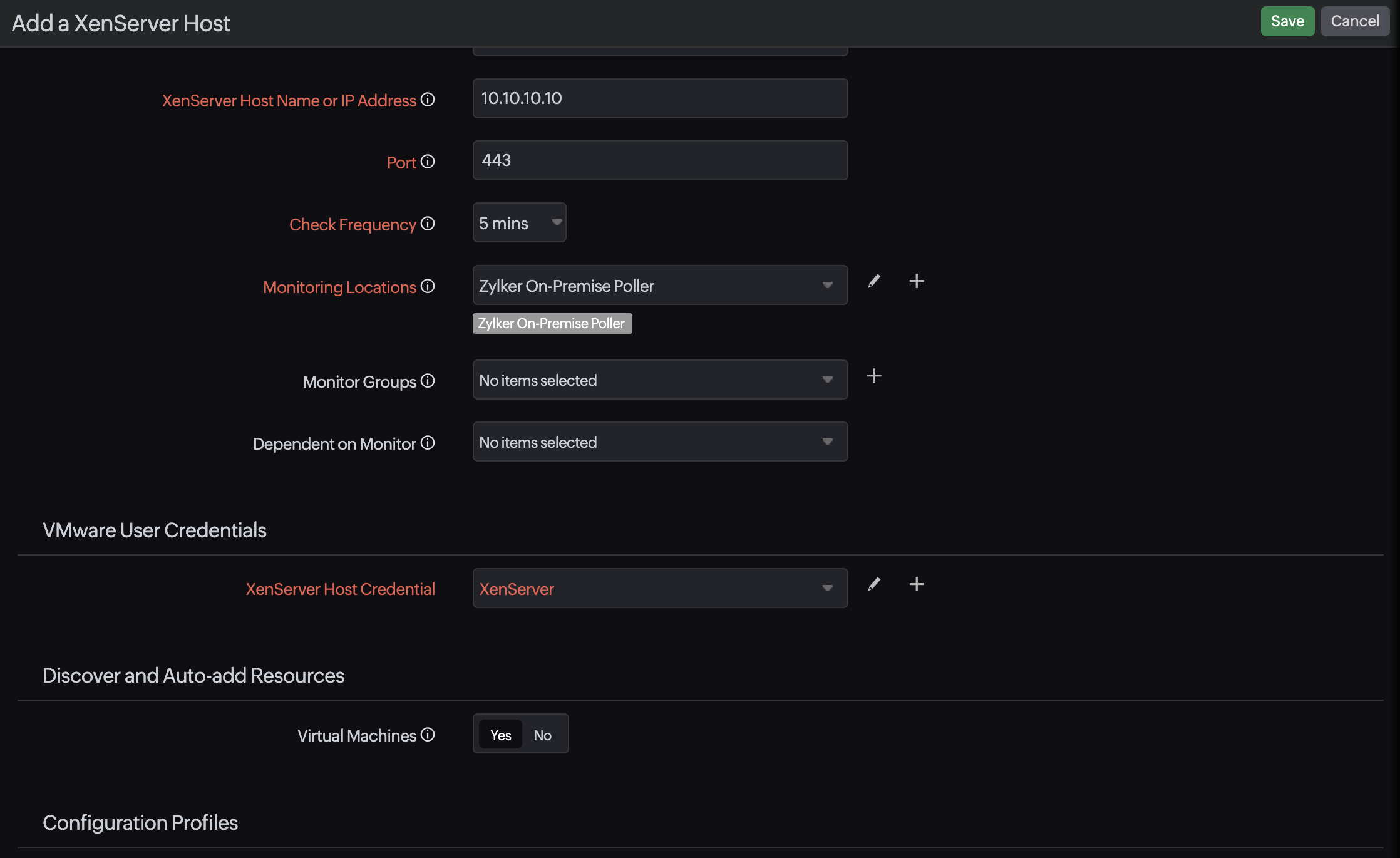
Verify the added XenServer host
To view the discovered monitors, follow the steps below:
- Navigate to VMware > XenServer Resources > Monitors.
- All the child and parent monitors will be displayed in one consolidated view.
- To edit the monitors' configuration, click the hamburger icon
 corresponding to the monitor's name and click Edit.